

A chilling whistleblower claim leads to high-stakes investigation
Dharmasthala, in Karnataka, famed for its Shri Manjunatha Temple and pilgrim presence, is at the centre of one of India’s most alarming recent allegations. In early July 2025, a former sanitation worker came forward with a confession that rocked the state: he claimed he was coerced, under threat of death to bury or burn the bodies of over 100 women and minor girls between 1995 and 2014, many showing signs of sexual assault, acid burns or strangulation .
The Whistleblower’s Testimony
- The ex-worker filed a formal complaint on July 3, registered as FIR No. 39/2025 under Section 211(a) of the Bharatiya Nyaya Sanhita .
- On July 11, he appeared masked before the Belthangady court to record a statement under Section 183 (equivalent to CrPC Section 164). He submitted skeletal remains and offered to identify burial sites and alleged perpetrators, in return for legal protection .
Alleged Methods & Victims
The allegations include details like:
- Disposal sites along the Netravathi River for rapid degradation and use of diesel or chemicals to burn bodies .
- Specific incidents, including a 12–15-year-old schoolgirl near a petrol pump in 2010 and a 20-year-old woman disfigured by acid .
Response from Activists & Legal Community
- The Karnataka State Women’s Commission, led by Nagalakshmi Choudhary, demanded a Special Investigation Team (SIT) following media reports and the skull recovery .
- Former Supreme Court Justice V. Gopala Gowda, along with senior advocates, urged for a court-monitored SIT, citing previous botched inquiries like the 2012 Sowjanya rape-murder case, which had ended in acquittal amid widespread distrust .
Government Action & SIT Formation
- On July 19, the Siddaramaiah government officially constituted a high-profile SIT led by DGP Pronab Mohanty, alongside DIG M.N. Anucheth and SP Jitendra Kumar Dayama .
- State authorities assured the public that no one will be protected and the probe will be thorough and unbiased .
Political Escalation
Calls have escalated beyond state structures:
- MP Santhosh P. Kumar (CPI) urged the Union Home Ministry to hand over the case to the National Investigation Agency (NIA), alleging signs of an organised crime network that operated under administrative silence for decades .
New Case Revealed: ANANYA BHAT (2003)
- On July 15, the mother of a medical student, missing since 2003 during a trip to Dharmasthala, filed a fresh plea seeking answers. She suspects her daughter may be part of the mass burial victims .
Why This Case Matters
| Factor | Significance |
|---|---|
| Scale | Alleged more than 500 victims over ~20 years, reportedly including young girls and women, markedly high compared to normal death rates in the area. |
| Institutional Failure | Previous cases like Sowjanya remained unresolved; families allege police inaction and influence suppression. |
| Social Power Dynamics | The allegations involve potential collusion by influential individuals linked to temple administration. |
| Justice and Forensics | Demand for DNA testing, exhumations and campus-wide forensic support underscores complexities ahead. |
Current Status & What’s Ahead (as of July 22, 2025)
- FIR registered, whistleblower protected under the Witness Protection Scheme 2018. He has offered to cooperate further under safety guarantees .
- SIT operational under senior IPS leadership, tasked with examining all related cases, exhuming remains (pending court sanction) and generating forensic and legal analysis .
- Advocacy groups push for judicial oversight, with retired justice and activists expressing concern over delays and impartiality .
- MPs and activists continue pushing for NIA takeover, citing national security and scale of allegations .
Conclusion
The Dharmasthala mass burial allegations have unleashed a saga of tragic claims and mounting public pressure. What began as a lone confession has evolved into demands for a robust, transparent investigation. The formation of the SIT led by senior officers marks a turning point, but the road ahead involves securing evidence, exhuming burial sites, protecting witnesses and holding influential individuals accountable. For justice seekers and families of missing women, the stakes couldn’t be higher.
Key Takeaways
- Alleged mass disposal of victims (mostly young women and children) over nearly two decades.
- Legal and activist pressure for SIT and possible NIA takeover.
- Government formed SIT, promised impartiality.
- Ongoing forensic and judicial scrutiny, high public interest.
Sources:
- Women’s panel demands SIT for Dharmasthala case
- CM: Awaiting police report, will form SIT if needed
- Govt open to probe, no one will be protected: Gundu Rao
- Mother seeks probe in daughter’s 2003 disappearance
- Calls for SIT intensify in Karnataka temple town mass burials case
- Timeline of Dharmasthala mass burial allegations
- Dharmasthala temple finally breaks silence
- SIT formed, led by DGP Pronab Mohanty
- Retired SC judge, advocates demand court-monitored SIT
- Wikipedia: Dharmasthala Mass Burials

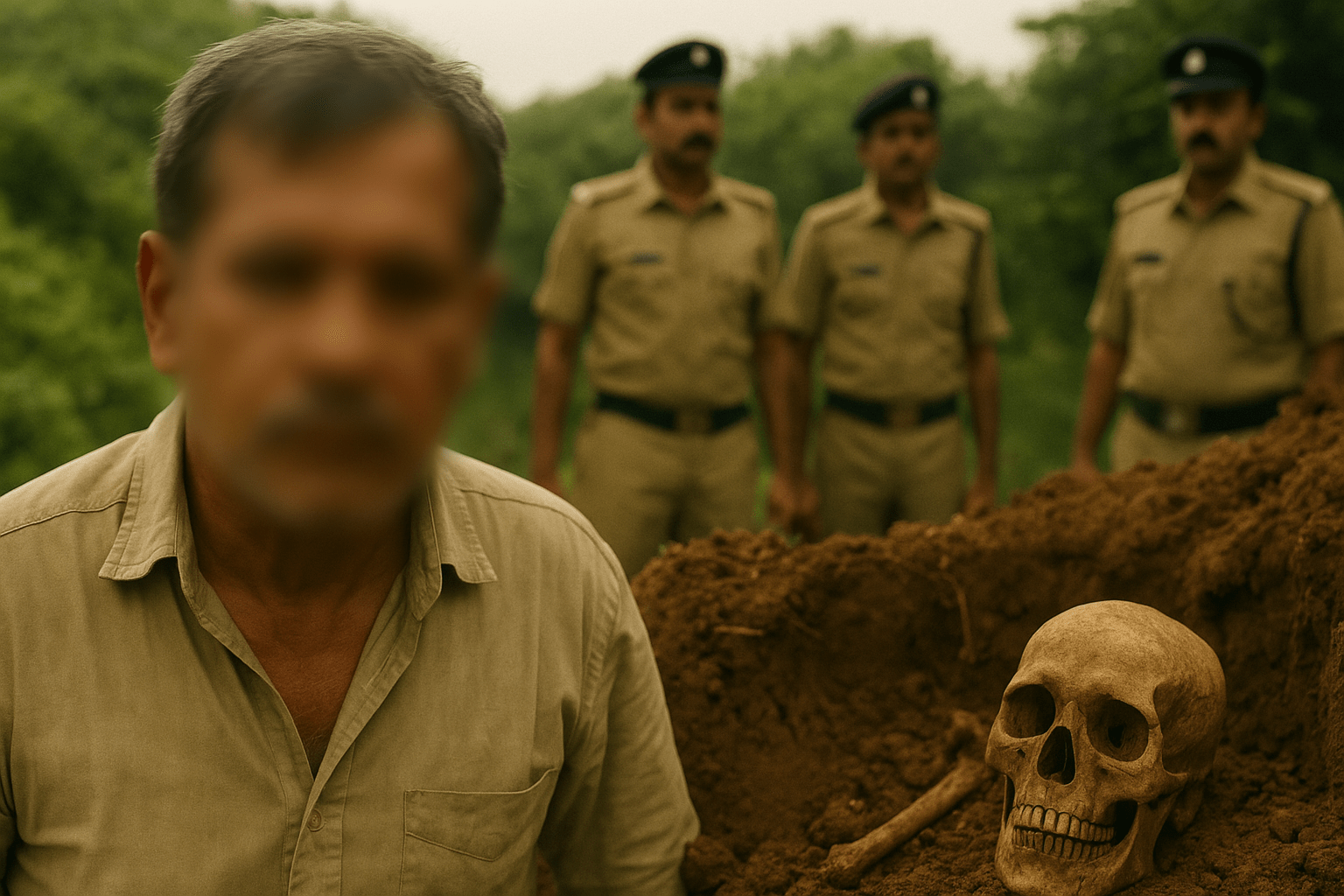
Image shown is for illustrative representation only and does not depict actual persons or events.


