


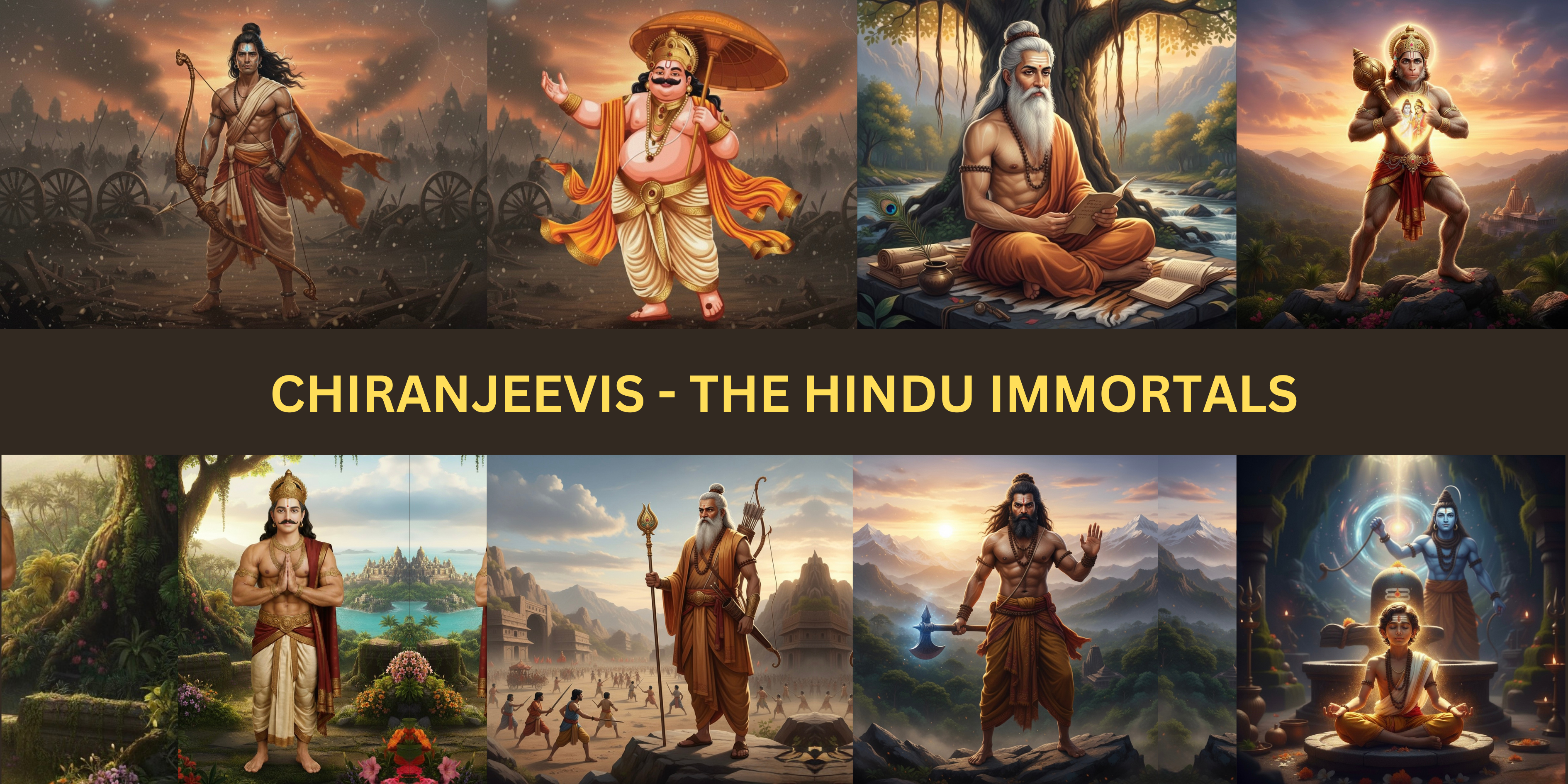
The Sanskrit word Chiranjeevi means “The Immortals” – beings blessed or cursed with eternal life. It derives from chira, meaning “eternal,” and jivi, meaning “living” or “life.”
In Indian mythology, there are eight such immortals, called the Ashta Chiranjeevis. These extraordinary beings were granted immortality – not to escape death, but to carry timeless lessons for humanity.
Each of these immortals represents a different human quality, like courage, devotion, wisdom, repentance, humility, faith or righteousness – and their stories come from India’s two great ancient epics:
- the Mahabharata, which is about a great war between two royal families, exploring duty, truth and human struggle.
- the Ramayana, which tells the story of Prince Rama and his journey to rescue his wife from a demon king, Ravana
A Brief of The Eight Immortals and Their Lessons
- Ashwatthama – A warrior who fought in the great war. He made a terrible mistake in anger and was cursed to live forever with regret. Lesson: Anger can destroy even the strongest heroes.
- Mahabali – A generous and kind king whose power became too great. When the god Vishnu appeared as a humble dwarf to test him, Mahabali offered everything he had – even his crown. Lesson: True greatness lies in humility and sacrifice.
- Vedavyasa – The wise sage who wrote the Mahabharata, one of the world’s longest and most profound epics. Lesson: Knowledge outlives time.
- Hanuman – The monkey-god known for his immense strength and loyalty to Lord Rama. Lesson: Unshakeable devotion and faith make you truly powerful.
- Vibhishana – The brother of the demon king Ravana. He chose to side with truth and justice instead of family loyalty. Lesson: Stand for what is right, even if it means standing alone.
- Kripacharya – A wise teacher who survived the great war and continued guiding future generations. Lesson: Wisdom and duty never grow old.
- Parashurama – A warrior sage, said to be an incarnation of the god Vishnu, who lives through different ages to protect justice. Lesson: Righteous action must continue across time.
- Markandeya – A young devotee who was destined to die early but was blessed with eternal life because of his pure devotion to God. Lesson: Faith can conquer even death.
.
1. Ashwatthama – The Warrior Cursed with Eternal Life

Background
Ashwatthama was the son of Dronacharya, the royal teacher of both the Pandavas and Kauravas, the two families at war in the Mahabharata. He was a mighty warrior, trained in advanced weapons and combat, and deeply devoted to his father. Both father and son were allies, fighting for the Kaurava side. During the Kurukshetra war, the Kauravas were gradually losing ground against the Pandavas.
The Pandavas knew that as long as Dronacharya, the Kaurava army’s greatest teacher and the greatest warrior of his age, was fighting, the Kauravas would remain very difficult to defeat. His skill, strategy and leadership made their army almost unbeatable. They realised that he was unstoppable only as long as he believed his son was safe and therefore neutralising him was key to turning the tide of the war.
The Deception
The Pandavas knew that as long as Dronacharya was fighting, the war could not be won.
So, Yudhishthira, the eldest Pandava, renowned for his truthfulness, was asked to trick Dronacharya.
- Plan: They decided to convince Drona that his beloved son, Ashwatthama, had died.
- Yudhishthira hesitated because it would involve lying , something he always avoided.
So to make it more believable, Bhima killed an elephant named Ashwatthama and loudly proclaimed its death, so that Dronacharya would hear. Dronacharya, trusting the word of Yudhishthira who eventually said: “Ashwatthama is dead.”, sat down in meditation and laid down his weapons, overwhelmed with grief. He ceased fighting, allowing the Pandavas to overpower him. Dronacharya was killed. The Pandavas decapitated him while he was in meditation.
Ashwatthama’s Rage
When Ashwatthama eventually learned that his father was dead, he was overcome with grief and fury. He blamed the Pandavas for tricking Dronacharya, and vowed vengeance.
- In a night-time raid after the war had ended, he attacked the Pandava camp.
- He killed many soldiers unarmed and sleeping, including Uttara’s (wife of Abhimanyu who was the son of Arjuna), unborn child – an act that shocked everyone.
For this heinous act, Krishna, the god and charioteer of Arjuna, cursed Ashwatthama:
He would live forever, carrying the weight of his sins, with wounds that never heal, wandering the earth in pain and loneliness.
Moral of the Story
- Grief can cloud judgment: Ashwatthama’s love for his father made him vulnerable to act impulsively and make tragic choices.
- Anger and revenge have consequences: His rage led him to commit atrocities that earned him a painful immortality.
- Immortality is not always a blessing: In Ashwatthama’s case, living forever became a punishment rather than a gift.
🕊️ Immortality without peace is not a gift, it’s a reminder that uncontrolled anger and revenge can destroy even great souls.
.
2. King Mahabali – The Generous Demon King Humbled by God

Background:
King Mahabali was an Asura (from a race often portrayed as demons) king who ruled the three worlds – heaven, earth and the underworld. Unlike many Asuras, he was just, generous and beloved by his people. His reign was marked by prosperity, fairness and devotion to his subjects.
Mahabali’s growing power, however, alarmed the gods. They feared that he might upset the cosmic balance and threaten the heavens.
The Divine Intervention
To restore balance, Vishnu, the preserver god in Hinduism, decided to intervene.
- He took the form of a dwarf Brahmin boy, named Vamana, and approached Mahabali during a ritual.
- Vamana asked the king for a seemingly modest gift: “Three steps of land, measured by my stride.”
Mahabali’s Humility and Wisdom
- Mahabali, known for his generosity, agreed without hesitation, even though his advisors warned him that this might be dangerous.
- Vamana then grew to cosmic proportions, stretching across the entire universe.
- With his first step, he covered the earth.
- With his second step, he covered the sky.
With nowhere left for the third step, Mahabali bowed his own head and offered it for Vamana to place his final stride.
The Blessing of Immortality
- Vishnu was pleased with Mahabali’s humility and devotion.
- Instead of punishing him, Vishnu granted Mahabali immortality, allowing him to live forever as a symbol of devotion, righteousness and generosity.
- He was also allowed to return to his kingdom once a year to bless his people, a tradition celebrated as the festival Onam in Kerala, South India.
Moral of the Story
- True greatness lies in humility: Even a powerful king is nothing without virtue.
- Generosity and selflessness are eternal values: Mahabali’s willingness to give everything, even his own head, shows the power of surrendering ego.
- Immortality is symbolic: Mahabali lives on in legend not through power, but through the lessons he left for humanity.
🕊️ True greatness comes not from power, but from humility and selflessness.
.
3. Vedavyasa – The Eternal Sage of Wisdom

Background:
Vedavyasa, also known as Vyasa or Krishna Dvaipayana, is considered a divine sage and the compiler of the Vedas – the most sacred scriptures of Hinduism. His name “Vedavyasa” literally means “the one who divided and organized the Vedas.” He was born to Sage Parashara and Satyavati, who later became the mother of King Vichitravirya – making Vedavyasa the grandfather of both the Pandavas and Kauravas in the Mahabharata. When Vyasa was born, he appeared as a fully grown sage, radiant and filled with divine knowledge. He was born on an island in the Yamuna river, which is why he was called Dvaipayana (“the island-born”).
The Sage Who Shaped Knowledge
Vedavyasa lived during a time when spiritual knowledge was vast and scattered.
- He took on the monumental task of classifying the Vedas into four parts – Rig, Yajur, Sama and Atharva – so that they could be studied and preserved by future generations.
- He also composed the Mahabharata, one of the greatest epics in world literature, containing stories of duty, devotion and destiny.
- Within the Mahabharata, he also included the Bhagavad Gita, a timeless philosophical dialogue between Krishna and Arjuna.
Through his work, Vyasa became not just a sage but a bridge between divine wisdom and human understanding.
Divine Role and Immortality
- Vedavyasa’s contribution was not limited to writing. He was a spiritual guide who appeared throughout ages to guide humanity in times of moral confusion.
- His immense wisdom and devotion earned him a place among the immortals (Chiranjivi), destined to live through the ages and reappear when dharma (righteousness) declines.
- As the grandfather of both the Pandavas and Kauravas, Vyasa guided them through wisdom, reflection and foresight.
- It is said he still resides in meditation in the Himalayas, appearing in different ages whenever righteousness (dharma) needs restoration. His body may have vanished from sight, but his presence lives eternally through his scriptures and teachings. He exists not as a man of flesh, but as an eternal teacher. He transcended the cycle of birth and death and continues to exist in spiritual form, guiding sages and seekers who are ready for true wisdom.
Moral of the Story
- Knowledge is eternal: True wisdom transcends time and continues to guide generations.
- Service to truth is divine: Vyasa dedicated his life to preserving sacred knowledge for the welfare of humanity.
- Immortality lies in contribution, not in existence: Vyasa lives forever through his teachings and the spiritual legacy he left behind.
🕊️ Knowledge and wisdom never die. They live eternally through words, learning and guidance.
.
4. Hanuman – The Devotee of Infinite Strength and Faith

Background:
Hanuman is perhaps the most beloved character in Indian mythology. A monkey-god and a loyal devotee of Lord Rama. He was born to Anjana (celestial nymph mother) and Kesari (vanara/monkey chief father), by the divine grace of the wind god, Vayu, making him the son of the wind (Pavanputra) as well. From birth, he possessed immense strength, courage and energy. As a child, his divine power was limitless and his playful curiosity, boundless.
Once, seeing the rising sun glowing like a ripe fruit, young Hanuman leapt into the sky to eat it, mistaking it for food. His act startled the gods, and Indra struck him with his thunderbolt, sending him crashing to the earth. Vayu, enraged and grief-stricken, withdrew air from the world, suffocating all beings. The gods, realising Hanuman’s divine nature, rushed to appease Vayu. They revived Hanuman and blessed him with extraordinary powers – strength, wisdom, fearlessness and longevity.
Divine Blessings and Immortality
To calm Vayu’s fury and honor Hanuman’s divine nature, each god bestowed a boon upon Hanuman:
- Brahma granted him immunity from all weapons.
- Indra blessed him that his body would be as strong as his thunderbolt.
- Agni (fire god) promised that fire would never harm him.
- Vayu (wind god) gave him the power to move anywhere, faster than thought.
- Yama (god of death) blessed him with immortality — that death would never touch him as long as he lived to serve righteousness (dharma).
Thus, Hanuman became one of the immortals (Chiranjivis), destined to live through all ages, as a symbol of devotion, strength and selfless service.
Devotion to Lord Rama
Hanuman’s greatest virtue was not his strength, but his devotion. When he met Lord Rama during the search for Sita, he became his most loyal servant and messenger. Hanuman’s faith was so deep that he saw Rama not as a king, but as God himself.
When King Rama’s wife, Sita, was kidnapped by the demon king Ravana, Hanuman leapt across the ocean to find her, burned the city of Lanka, carried an entire mountain bringing the life-restoring herb Sanjeevani to save Lakshmana, Rama’s brother’s life, and served Rama selflessly in every battle – all out of pure love and devotion.
Once, someone asked Hanuman how deep his devotion was. Smiling, Hanuman tore open his chest, and within his beating heart appeared Lord Rama and Sita, shining in divine light – showing that they lived within him, eternally.
After Rama’s victory, when the Lord returned to his divine abode, Hanuman chose to remain on earth, to continue singing Rama’s name until the end of time.
Immortality and Eternal Presence
Hanuman lives forever as the eternal devotee, present wherever Rama’s story (the Ramayana) is recited. It is said that his divine presence blesses anyone who remembers him with sincerity. Even today, Hanuman is believed to be alive – unseen, but always near, embodying faith, strength and divine protection. He was blessed to remain alive as long as people continue to chant Rama’s name.
Moral of the Story
- True strength comes from devotion, not power.
- Selfless service and humility make one truly immortal.
- Hanuman’s life teaches that pure love for the divine conquers fear, ego and even death.
🕊️ Real power comes from pure devotion and faith – not ego or pride.
.
5. Vibhishana – The Voice of Conscience in a Family of Darkness

Background:
Vibhishana was the younger brother of Ravana, the mighty king of Lanka (Now, Sri Lanka), and Kumbhakarna. All three were born to the sage Vishrava and the demoness Kaikesi, making Vibhishana a Rakshasa (demon) by birth, yet vastly different in heart and spirit.
Though feared for his ambition and strength, Ravana was also an extraordinary scholar and a great devotee of Lord Shiva. While he sought power and dominance through austerities and ambition, Vibhishana turned inward, meditating on Lord Vishnu and seeking truth and righteousness (dharma). From a young age, he rejected cruelty and arrogance, embracing a path of compassion and devotion even among demons.
Loyalty Tested
Ravana received several boons from the gods, mainly due to his severe austerities and devotion to Lord Shiva, like near invincibility and protection from death, but despite all that Ravana’s pride and ego led him to abduct Sita (wife of Rama), that ultimately led to his downfall. When he brought her to Lanka, Vibhishana’s conscience was shaken. He tried to reason with his brother, urging him to return Sita to Rama and avoid destruction.
“Brother,” he said, “you have everything – power, wisdom, wealth and glory. Why invite ruin by defying dharma?”
But Ravana’s pride blinded him. He mocked Vibhishana’s words and accused him of betrayal. Heartbroken, Vibhishana bowed his head and said, “My loyalty to righteousness is greater than my loyalty to blood.” He left Lanka, not as a coward, but as a man who chose truth over kinship.
Alliance with Rama
Vibhishana crossed the ocean and appeared before Rama’s army. Though the monkey warriors doubted him, Rama saw the purity in his heart. He accepted Vibhishana’s surrender, embraced him, and said, “A man who seeks refuge in righteousness is never an enemy.”
Throughout the war, Vibhishana guided Rama, revealing Ravana’s secret vulnerability: “The only way to kill Ravana is to strike his navel, for that is where his immortality rests. All other attacks will fail.” Guided by Vibhishana, Rama aimed his ultimate weapon, the divine Brahmastra, at Ravana’s belly, and finally defeated the mighty demon king.
When Ravana was finally slain, Rama placed the crown of Lanka on Vibhishana’s head, declaring him its rightful ruler.
Immortality and Divine Blessing
After the war, Vibhishana ruled Lanka with wisdom and fairness. He became a protector of dharma in the realm of demons, ensuring that even those born in darkness had a guardian of light.
Lord Rama, before returning to Ayodhya, blessed him saying: “Remain on earth until the end of this age (Kali Yuga), to guide souls and uphold righteousness among beings.”
1. Satya Yuga – The age of truth and virtue, lasting 1,728,000 years.
2. Treta Yuga – The age of heroes and declining dharma, lasting 1,296,000 years.
3. Dvapara Yuga – The age of conflicts and partial righteousness, lasting 864,000 years.
4. Kali Yuga – The age of strife and moral decline, lasting 432,000 years; we are currently in this age, and after it ends, the
the world will renew itself and the cosmic cycle is believed to restart with Satya Yuga.
Thus, Vibhishana became one of the immortals, living as a symbol of integrity, faith and the triumph of righteousness even in a corrupt world.
Moral of the Story
- True courage is standing for what is right, even against one’s own family.
- Righteousness has no caste, clan or bloodline – only conviction.
- Vibhishana’s immortality reminds us that dharma survives even among demons.
- Even the greatest devotion cannot protect one from ego and unrighteousness.
🕊️ Standing up for truth sometimes means walking away from your own family, but virtue is its own reward.
.
6. Kripacharya – The Ever-Living Teacher

Background:
Kripacharya, also called Kripa, was born to the sage Sharadvan and the celestial nymph Janapadi, but his father abandoned him and his twin sister Kripi out of shame and fear of judgment for breaking his vow of celibacy. Later, King Shantanu, while hunting, discovered the miraculous twins alive and glowing with divine energy, nourished by the forest itself. Moved by their purity, he adopted and raised them, naming the boy Kripa (meaning “compassion”) and his sister Kripi. From a young age, Kripa showed extraordinary talent in archery, martial arts and Vedic wisdom, earning a reputation as a brilliant scholar and warrior.
Role as a Teacher and Warrior
Kripacharya became the royal guru of the Kuru princes, teaching both the Pandavas and Kauravas, the arts of warfare, archery and discipline. He was respected for his knowledge, fairness and integrity, never letting favouritism or personal ambition guide his actions.
During the Kurukshetra war, Kripa fought on the Kaurava side, alongside Drona, Ashwatthama and Karna (the son of Kunti and the Sun God Surya, was a demigod and a great warrior in the Mahabharata, renowned for his bravery, generosity, and loyalty despite facing many hardships in life). Though the war tested Kripas loyalty, he maintained his moral compass, fighting with skill and honour. After the war, he was one of the few survivors of the Kaurava army, continuing to guide kings and warriors with wisdom.
Immortality and Divine Blessing
Kripacharya’s immortality was granted by the gods and sages, recognizing his lifelong dedication to teaching, righteousness and the preservation of dharma.
- His immortality symbolizes the enduring power of knowledge, guidance and moral steadfastness, rather than invincibility in battle.
- Even today, it is said he still lives, guiding seekers and preserving dharma through his eternal presence.
Moral of the Story
- True immortality lies in teaching and preserving wisdom.
- Loyalty, discipline and righteousness endure beyond the battlefield.
- Kripacharya’s life teaches that guiding others and upholding dharma is the highest form of legacy.
🕊️ True teachers never die, their knowledge continues to guide humanity forever.
.
7. Parashurama – The Warrior Sage and Eternal Guardian

Background
Parashurama, whose name means “Rama with the Axe,” was the son of Sage Jamadagni and Renuka Devi. He was born into a priestly (Brahmin) family, yet possessed the strength, courage and warrior spirit of a Kshatriya (the ruling and soldier class). Trained by Lord Shiva, he was blessed with the divine axe Parashu, which became his signature weapon. In that era, many kings had become arrogant and unjust, using power to oppress the weak and Parashurama’s destiny was to restore balance between good and evil.
The War Against Corruption
The story began when King Kartavirya Arjuna, a mighty but arrogant ruler, visited Parashurama’s hermitage. He coveted a sacred wish-fulfilling cow that belonged to Parashurama’s father, Sage Jamadagni, and seized it by force. Parashurama, enraged at the injustice, killed the king in battle. But the king’s sons sought revenge. They attacked the hermitage and murdered Parashurama’s father while he was meditating. Heartbroken and furious, Parashurama vowed to rid the earth of all corrupt Kshatriyas (warrior class) who had forsaken dharma (righteousness). He carried out his vow with divine power, defeating and destroying the Kshatriya class twenty-one times to cleanse the world of their arrogance.
The Path to Peace
After his vengeance was fulfilled, Parashurama realized that endless violence could not bring true justice. He laid down his axe, renounced anger and turned to penance and teaching. He later became a revered guru to legendary warriors – Bhishma, Dronacharya and Karna – who shaped the epic Mahabharata. When he met Lord Rama (the next incarnation of Vishnu), he realised that his divine role as protector of dharma had ended, and he humbly withdrew from worldly affairs.
Immortality
For his devotion to dharma and his tireless service to restoring justice, Parashurama was granted immortality. It is believed that he still lives in the Mahendra Mountains, continuing his meditation until the end of time. He is one of the immortals in Hindu mythology, destined to appear again to train future warriors and uphold righteousness in future ages. He is believed to have lived in many ages (Yugas), and that he still resides on earth, waiting to train the next divine warrior, the future avatar Kalki (10th & final avatar of Lord Vishnu prophesied to appear at the end of the Kali Yuga – the current age of darkness, to destroy wickedness and usher in a new, brighter age).
Moral of the Story
- Righteous anger must be guided by wisdom: Parashurama’s fury began with justice but almost consumed him.
- True strength lies in restraint: Even the mightiest warrior must learn when to lay down his weapon.
- Balance is dharma: His life teaches that the purpose of power is not destruction, but restoration of harmony.
🕊️ Righteous action and protection of truth are eternal duties.
.
8. Markandeya – The Boy Who Conquered Death through Devotion
Background
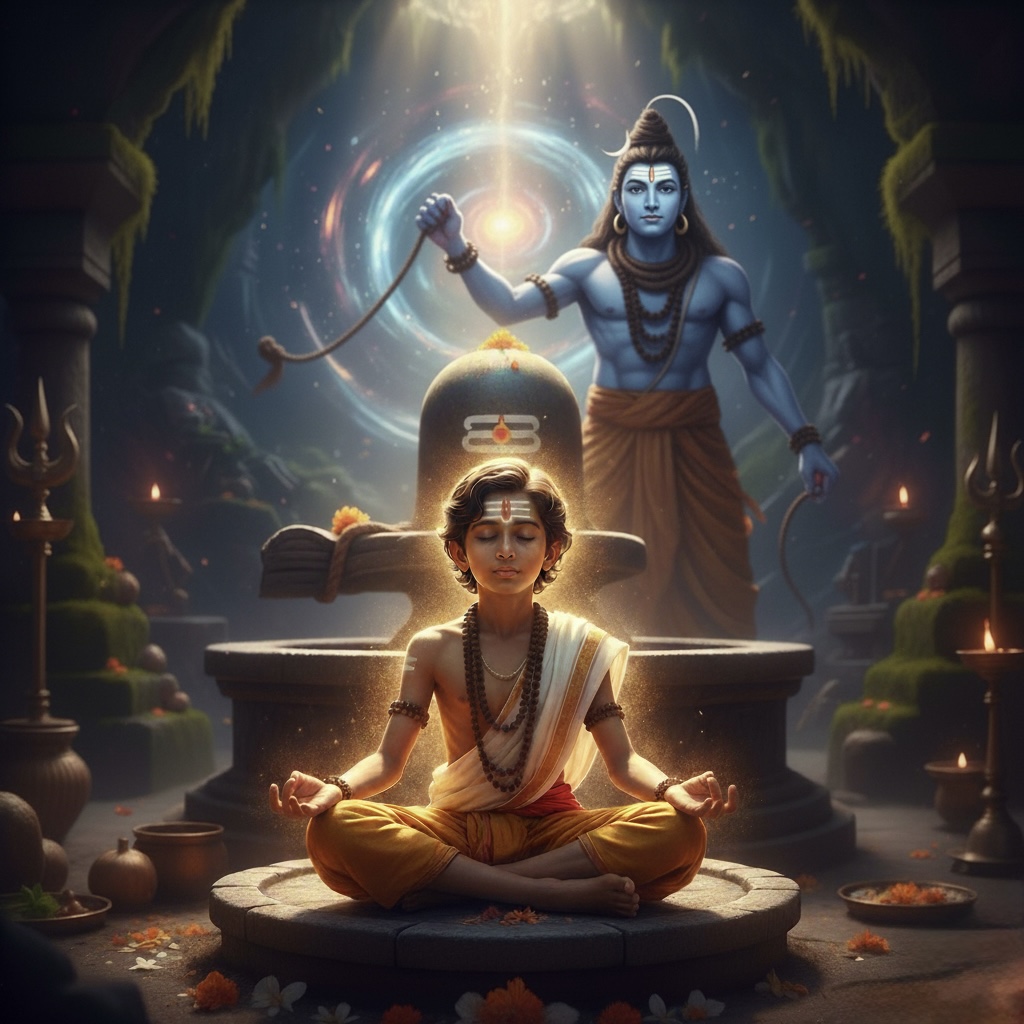
Markandeya was born to Sage Mrikandu and his wife Marudmati, who longed for a child. They prayed to Lord Shiva for a son and were given a choice: they could have a child with great intelligence and virtue who would die young, or a child of ordinary abilities who would live a long life. They chose the virtuous child and Markandeya was born. Unfortunately, it was foretold that he would die at the age of 16. Markandeya grew up to be exceptionally devoted to Lord Shiva, spending his days in prayer, meditation and spiritual practices. He became a model of discipline, wisdom and devotion even at a very young age.
The Moment of Death
When Markandeya turned 16, Yama, the god of death, came to claim his life. Markandeya, realizing that his end had come, clung to the Shiva Lingam in his home and prayed with all his heart. Yama tried to take his life, but Markandeya’s pure devotion and faith in Shiva made the deity appear before Yama. Lord Shiva, moved by his devotee’s unwavering devotion, intervened and defeated Yama, declaring that Markandeya would be immortal. From that day, Markandeya became one of the Chiranjivis, the immortals in Hindu mythology.
Role and Legacy
- Markandeya is remembered as a symbol of devotion, faith and spiritual discipline.
- He is said to have authored many hymns and scriptures and is often associated with the Markandeya Purana, which contains stories of the goddess Durga and other divine teachings.
- His life is celebrated as an example that true devotion can transcend even death.
Immortality
Because of his devotion to Lord Shiva, Markandeya was granted immortality, allowing him to witness the world through many ages. He continues to be a living symbol of faith and righteousness, inspiring generations of devotees to turn to the divine in times of fear and uncertainty.
Moral of the Story
- Devotion conquers fear: Markandeya’s faith in Shiva protected him from death itself.
- Virtue is greater than lifespan: A life of righteousness and discipline is more valuable than mere longevity.
- Gods respond to pure faith: The story emphasises that unwavering devotion and sincerity can bring divine protection and blessings.
🕊️ True faith can overcome even fate. Devotion can make one immortal.
🌸 The Deeper Message of Chirajeevinah
The dance doesn’t just show myths — it explores what immortality really means.
It’s not about living forever in body, but about living forever in spirit, virtue and the impact we leave behind.
Each immortal stands as a reminder that values – truth, faith, humility, wisdom and love – never die.


 A Philomath’s Journal